
Executive Insight: The Current State of Real Estate Investments
By: Kyle D. Henderson, President of Sandgaard Capital
As we close out 2025, real estate investing remains a complex and dynamic component of diversified portfolios. Across residential and commercial sectors, divergent trends driven by macroeconomic conditions, capital markets evolution, shifting occupier and consumer behavior, and technological change are shaping near-term performance and strategic opportunity sets.
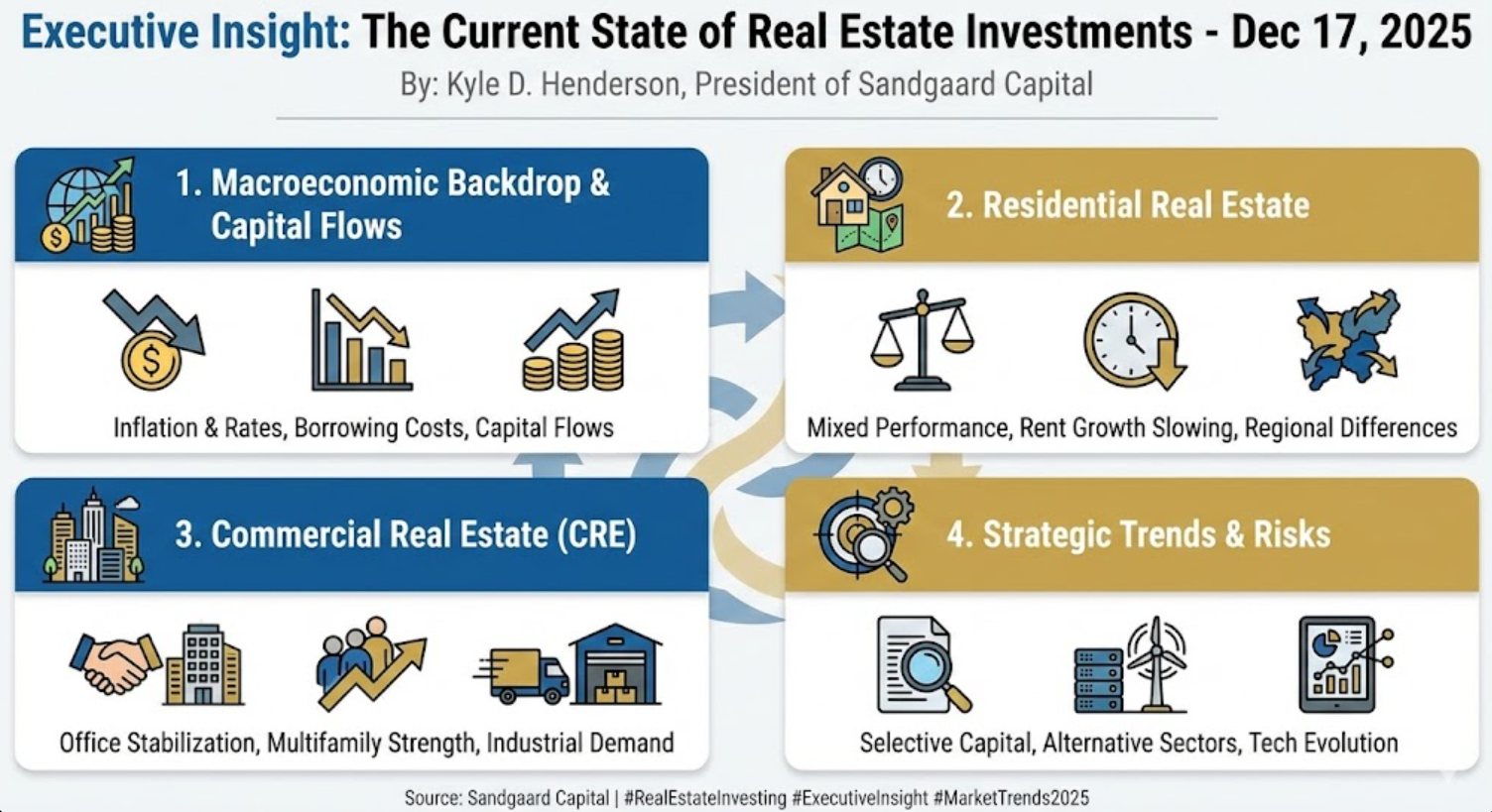
1. Macroeconomic Backdrop and Capital Flows
Persistent inflation pressures and elevated interest rates have defined much of 2025, though late-cycle easing has begun to emerge in financial markets. These conditions have materially influenced borrowing costs, investment pacing, and capital allocation decisions.
Borrowing cost sensitivity continues to suppress transaction volume in rate-sensitive sectors, with capital deployed selectively toward assets demonstrating durable cash flow, defensive characteristics, and strong sponsorship. Institutional capital remains cautious, with allocations to real estate still below pre-pandemic norms in many portfolios, even as valuation stability improves. At the same time, global private wealth growth continues to expand the pool of investors seeking income-producing real assets as a complement to public equities.
2. Residential Real Estate
The residential real estate market continues to exhibit mixed but broadly resilient performance.
Total U.S. residential property values reached historic highs in mid-2025, reflecting cumulative appreciation over the prior cycle. However, rent growth has slowed materially, indicating moderation in rental inflation even as absolute rent levels remain elevated compared to earlier years. Home price performance remains highly regional, with certain markets still experiencing appreciation while others show stabilization or modest declines driven by affordability constraints and local economic conditions.
For investors, residential strategies remain compelling where supply is structurally constrained, migration trends are favorable, or operational scale supports consistent cash-flow generation. Build-to-rent platforms and long-term rental portfolios continue to attract institutional interest.
3. Commercial Real Estate (CRE)
Commercial real estate is undergoing a measured transition marked by sector-specific divergence.
Office
Office markets are showing early signs of stabilization, particularly in high-quality, well-located Class A assets. Occupancy improvements remain uneven, and refinancing pressure continues for assets facing near-term debt maturities, especially in secondary markets or older product.
Multifamily
Multifamily remains one of the strongest CRE sectors. Demand from renters persists, effective supply remains relatively tight in many markets, and investor interest continues to outpace other property types. Pricing and transaction activity in multifamily have consistently led broader CRE performance.
Industrial and Logistics
Industrial real estate continues to benefit from structural e-commerce demand and supply-chain reconfiguration. While rent growth has moderated as new supply delivers, long-term fundamentals remain supportive.
Retail and Hospitality
Retail has demonstrated notable resilience, supported by consumer spending and disciplined new development. Hospitality performance has rebounded strongly, with occupancy and revenue metrics exceeding pre-pandemic levels in many leisure-oriented markets, though urban and convention-driven assets remain more variable.
Overall, transaction pricing across CRE improved during 2025, with multifamily and industrial leading gains and other sectors showing incremental recovery.
4. Strategic Trends and Emerging Themes
Selective Capital Deployment
Investors are prioritizing asset quality, tenant durability, and sustainable income over speculative appreciation. Underwriting discipline and conservative leverage structures remain central to capital allocation decisions.
Alternative Real Estate and Specialized Sectors
Non-traditional real estate segments are increasingly incorporated into diversified portfolios. Build-to-rent communities, senior housing, life sciences facilities, and data center infrastructure are being evaluated as growth complements to traditional CRE exposure.
Technology and Asset Management Evolution
Advances in data analytics, valuation modeling, and tenant experience platforms are influencing acquisition strategy and asset management practices. Adoption remains uneven, but technology-enabled insights are increasingly viewed as a competitive advantage.
5. Risk Considerations
Real estate investing at this stage of the cycle presents several material risks. Refinancing headwinds remain significant for assets with near-term debt maturities, particularly where valuations have reset or income growth is constrained. Interest rate uncertainty continues to influence leverage costs and exit timing. Geographic and sector-specific dynamics require granular analysis, as aggregate market indicators can obscure localized challenges or opportunities.
Conclusion
The real estate investment landscape in late 2025 reflects a cautious normalization following years of volatility. While macroeconomic uncertainty and structural shifts persist, high-quality real assets with durable cash flows and strong fundamentals continue to offer attractive risk-adjusted opportunities. Disciplined capital deployment, sector selectivity, and active asset management remain essential for investors navigating this evolving environment.